
As part of our ongoing commitment to advancing Environmental, Social, and Governance (ESG) practices across the sealing industry – and to further strengthen the activities of the ESA ESG Working Group – we recently launched a survey among all our members.
We were delighted to receive many thoughtful responses from our valued members.
Below is a summary of the key findings. The survey was brief but designed to gather meaningful insights and encourage collaboration across our community.
What ESG Topics Are Most Important to Companies Today?
Our recent ESA member survey asked, “What ESG-related topics or challenges are most important to your company today?”
Across all responses, members emphasised a strong focus on environmental and supply chain issues, alongside compliance and social responsibility.
Top 3 Priorities Identified:
- Carbon footprint reduction & climate impact – including energy efficiency, renewable energy, and Scope 3 emissions.
- Sustainable supply chains & responsible procurement – transparency, circularity, and supplier engagement.
- Regulatory compliance & standards – meeting global environmental regulations and applying life-cycle assessment frameworks (LCA, EPD, PEF).
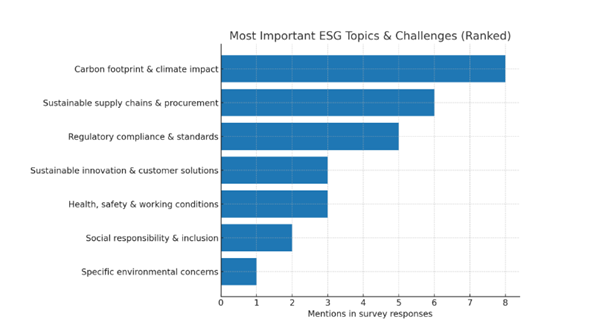
Other notable topics included sustainable innovation, workplace safety, and diversity & inclusion.
Which ESG Areas Should ESA Focus On?
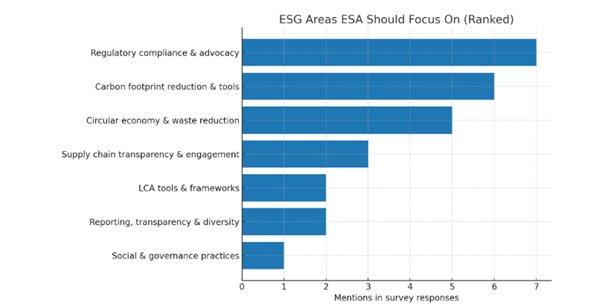
We also asked members, “Which ESG areas would you like to see ESA focus on or develop guidance, tools, or support for?”
Top 3 Areas Members Want ESA to Lead:
- Regulatory compliance & advocacy – guidance on regulations, practical impacts of legislation, early-stage advocacy (e.g., PFAS restrictions), standardisation support, compliance training.
- Carbon footprint reduction & tools – development of footprint calculators, data-sharing platforms, and industry guidance on reuse/recycling.
- Circular economy & waste reduction – encouraging repair, reuse, and sustainable material cycles across the industry.
Additional areas mentioned included supply chain transparency, LCA tool development, reporting frameworks, and social/governance best practices.
Key Takeaways
- Carbon and compliance dominate: Both company priorities and ESA expectations highlight the need for practical tools and clear guidance on carbon management and regulation.
- Collaboration opportunity: Members see ESA as a facilitator — especially in sharing best practices, harmonising reporting, and engaging the supply chain.
- Growing focus on circularity: Interest in circular economy initiatives continues to rise, suggesting future potential for ESA-led projects and frameworks.
Next Steps
ESA will use these insights to guide the development of:
- ESG guidance on regulations and practical impacts of legislation (e.g., PFAS restriction proposal, DWD, peroxides in elastomers for food applications)
- Collaborative tools for carbon footprint assessment and reporting,
- Place ESA entity into European Directive and Standards working groups (e.g., ISO, CEN,…)
- To represent the industry on key environmental and regulatory issues.
Stay tuned for updates on upcoming workshops and ESG working group initiatives.
To ensure our initiatives are relevant, impactful, and aligned with the needs of our members, we would greatly value your input. If you are not yet involved, please consider becoming an active member of the ESG Working Group. (Please contact Sandy Van den Broeck, ESG Director, ESA ESG Working Group)
Sandy Van den Broeck,
ESG Director, ESA