
Interesting news has been received from the European Parliament’s ITRE (Industry, Research and Energy) Committee, which published an independent study in which fluoropolymers are considered enablers of competitiveness. The study highlights the critical role of fluoropolymers in Europe’s strategic industry.
1. Role of fluoropolymers within PFAS
The study concentrates on six fluoropolymers—PTFE, PVDF, ETFE, FEP, PFA, and FKM/FFKM—which together account for around 93% of fluoropolymer use in Europe. These materials fall under the OECD definition of PFAS and are therefore included in the proposed Universal PFAS (UPFAS) restriction under REACH.
Fluoropolymers are distinguished from many other PFAS by:
- Long molecular chain structure and weight and polymeric structure.
- Exceptional thermal stability, chemical resistance, low friction, dielectric properties, and durability.
- Use primarily in industrial and strategic applications, rather than consumer dispersive uses.
- Fluoropolymers are PFAS of low concern
2. How fluoropolymers are treated in the PFAS restriction proposal
The UPFAS restriction dossier, as assessed in the study, considers two regulatory options:
- RO1: A near-total ban with an 18-month transition period
- RO2: A ban with use-specific, mostly time-limited derogations
Under both options, fluoropolymers are not automatically exempt, despite being polymers and despite their distinct risk profile compared with low-molecular-weight PFAS (e.g., PFOA, PFOS).
The study highlights that fluoropolymers are regulated as part of a broad PFAS group, rather than via a differentiated, risk-based approach.
This creates a high risk of unintended consequences for critical industrial value chains.
3. Substitution potential for fluoropolymers
The Analysis of Alternatives (AoA) finds that:
- Substitution is often technically infeasible for fluoropolymers in critical applications.
- Where alternatives exist, they usually fail to meet all required performance criteria, particularly:
- High temperature resistance
- Chemical inertness
- Long service life and safety
- Ultra-low contamination
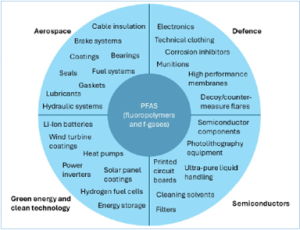
Source: ITRE document, authors’ own elaboration.
Sectoral findings:
- Aerospace & defence: fluoropolymers are used in seals, gaskets, wiring insulation, bearings, fuel systems, coatings, and engine components.
- Semiconductors: fluoropolymers are essential for ultra-high purity environments, chemical handling, tubing, seals, and contamination control.
- Green energy & clean technologies: used in lithium-ion batteries, hydrogen fuel cells (PEM membranes), solar panels, wind turbines, heat pumps.
Overall, the study concludes that application-by-application assessment is necessary, and blanket assumptions about substitutability are not supported by evidence.
4. Socio-economic and competitiveness implications
Because fluoropolymers are deeply embedded in strategic sectors, the study estimates very large impacts if they are restricted without adequate derogations.
Economic impact:
- First-year costs of ~€560 billion under both RO1 and RO2
- Annual recurring costs of ~€70+ billion
Industrial impact:
- At least 39,000 enterprises and ~2.9 million jobs potentially affected
- SMEs disproportionately exposed, particularly in clean technology supply chains
From a competitiveness perspective:
The EU could become one of the strictest jurisdictions globally on fluoropolymers.
Other regions (US, Canada, Asia) often exempt polymers of low concern, creating risks of:
- Production relocation
- Supply chain dependency on non-EU manufacturers
- Weakened EU strategic autonomy
5. Key conclusions on fluoropolymers in the PFAS restriction process
The study’s central conclusions regarding fluoropolymers are:
- Fluoropolymers are enablers of EU industrial competitiveness, not marginal or easily replaceable substances.
- Treating fluoropolymers identically to all PFAS does not reflect their distinct functionality, exposure pathways, or risk profile.
- A blanket PFAS restriction risks undermining EU climate, digital, defence, and industrial policy objectives.
6. Recommendations specific to fluoropolymers
The study recommends a more differentiated regulatory approach, including time-unlimited derogations for fluoropolymers and F-gases.
With a stronger focus on:
- Emission control
- End-of-life management
- Abatement and remediation technologies
Creation of innovation and investment funding to support long-term development of alternatives, rather than forcing premature substitution.
Final conclusion
Although this report reviews only a limited number of sectors and does not fully address several important application areas—such as sealing applications and other strategic industrial sectors—its findings convey a significantly more positive message than what has previously been communicated during the restriction process at ECHA.
The members of the European Sealing Association (ESA) look forward to a balanced and well-founded political decision on the management of the PFAS restriction process, guided by a pragmatic and proportionate approach, based on the following considerations:
- Fluoropolymers differ fundamentally from other PFAS substances, as they are non-hazardous and safe in their intended applications.
- Due to their unique material characteristics, there are currently no technically or economically viable alternatives for many critical uses.
- Fluoropolymers are essential to maintaining the competitiveness, innovation capacity, and strategic resilience of European industry.
Therefore, ESA, its members, and downstream users seek a specific exemption for fluoropolymers within the PFAS restriction framework.
Sandy Van den Broeck,
ESG Director, ESA
Source: Richards, R., White, R., Stenning R., 2025, The Per- and polyfluoroalkyl substances (PFAS) and their role as enablers in the competitiveness of European industry: Inception Report, publication for the Committee on Industry, Research and Energy (ITRE), Policy Department for Transformation, Innovation and Health, European Parliament, Luxembourg.
This document is available at: http://www.europarl.europa.eu/supporting-analyses.