The public consultation on the draft opinion of the European Chemicals Agency (ECHA) Committee for Socio-Economic Analysis (SEAC) regarding the proposed PFAS restriction closed on 25 May 2026, following a 60-day consultation period running from 26 March to 25 May 2026.
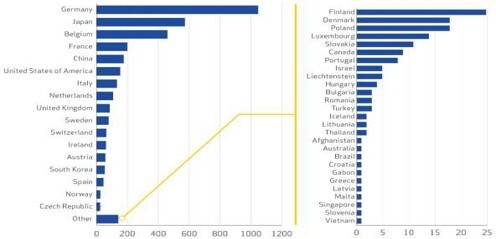
Count of comments per country. (Source: ECHA)
ESA, together with more than 3,200 organisations and 250 individuals, participated in the consultation, contributing to a total of 3,511 comments submitted to ECHA.
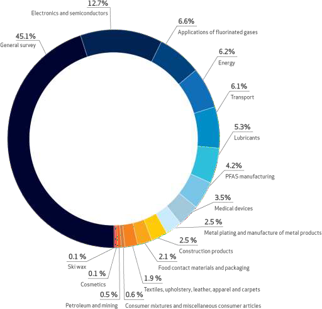
Comments by survey/sector. (Source: ECHA)
According to ECHA, 61.6% of all comments were submitted by companies, while a further 25.9% came from industry and trade associations. The consultation focused primarily on socio-economic considerations, particularly the availability of alternatives, transitional periods, cost implications, and potential impacts on competitiveness.
For many sectors—including life sciences, laboratory equipment, medical technology, electronics, energy, transportation, and fluorinated gases—the key challenge remains how to reconcile effective PFAS regulation with technical feasibility, security of supply, and continued innovation.
Next steps
SEAC is expected to adopt its final opinion by the end of 2026. This will conclude ECHA's scientific evaluation of the proposed restriction, after which the final opinions of SEAC and the Committee for Risk Assessment (RAC) will be formally submitted to the European Commission.
Based on these opinions, the Commission will prepare a restriction proposal for discussion and vote in the REACH Committee, which is composed of representatives of the EU Member States.
Sealing applications at risk
Under the baseline scenario without derogations, high-performance sealing applications represent a significant area of economic exposure. Estimated impacts indicate that sealing applications are associated with approximately €20 billion in output and 54,900 full-time equivalent (FTE) jobs at risk.
These figures highlight the scale of downstream industrial activity that depends on high-performance sealing technologies, particularly where evidence provided by manufacturers demonstrates that substitution is either technically unfeasible or cannot be achieved within the required timeframe.
Sealing applications are of strategic importance because they are embedded across a wide range of industrial sectors. High-performance fluoropolymer and perfluoroelastomer seals, gaskets, O-rings, mechanical seals, packings, and expansion joints are used in critical applications where reliability, chemical resistance, and long-term durability are essential under demanding operating conditions.
ESA’s position
The ESA maintains that PFAS used in sealing applications—primarily fluoropolymers and perfluoroelastomers should be excluded from the scope of the proposed restriction.
A horizontal, duty-based exclusion linked to demonstrable containment performance and credible end-of-life controls would constitute the most appropriate EU-wide regulatory approach.
Such an approach would better protect human health and the environment by preserving technologies that prevent fugitive emissions across industrial sectors. It would also align with SEAC's emphasis on practicality, enforceability, and monitorability, while avoiding the unintended consequences of increased leakage rates resulting from premature adoption of non-equivalent or technically unsuitable substitutes.
Next steps for the ESA
For the eight additional sectors, including Sealing Applications, that were not assessed during the SEAC consultation process, it remains unclear when and how the proposed detailed evaluation by SEAC will be carried out.
Therefore, ESA is considering the development of a proactive position paper outlining a structured approach that can be shared with industry stakeholders ahead of the anticipated sector-specific investigations by SEAC and/or ECHA.
The position paper will be supported by a Risk Assessment Database for non-PFAS materials, following a methodology broadly comparable to the approach used under the EC Machinery Directive.
ESA will therefore take a proactive role by developing an appropriate concept and compiling the necessary technical data.
The proposed approach should:
- Cover all sealing technologies represented within ESA.
- Be applicable to sealing applications across all relevant industrial sectors.
- Be coordinated with FSA and other relevant industry associations to ensure a consistent and harmonized approach.
As this project is still in progress, further updates and developments will be communicated in due course.
Sandy Van den Broeck,
ESG Director, ESA