The European industrial landscape is undergoing a profound transformation driven by sustainability goals, digitalisation, and regulatory evolution. At the heart of this shift are two closely related concepts: the Digital Product Passport (DPP) and the Digital Data Chain (DDC). Together, they represent a fundamental change in how product information is created, shared, and utilised across the entire lifecycle.
.png?width=300&height=300&name=DPP-nl(1).png)
From policy to practice: The European Green Deal
The foundation for these developments lies in the European Green Deal, the EU’s ambitious strategy to achieve climate neutrality by 2050. This initiative promotes emission reduction, circular economy principles, and sustainable product design. A central regulatory instrument supporting these goals is the Ecodesign for Sustainable Products Regulation (ESPR), which introduces new requirements for product transparency and sustainability.
The DPP emerges as a key tool within this framework. Its purpose is to provide standardised, accessible digital information about products throughout their lifecycle. This includes data on material composition, carbon footprint, repairability, and recyclability. By making such information available, the DPP enables better decision-making for manufacturers, regulators, and end users, while strengthening compliance with sustainability requirements.
Unlike traditional regulations, the ESPR acts as a horizontal framework. It does not define detailed requirements for specific products but instead establishes general principles such as transparency and circularity. Product-specific rules are introduced later through delegated acts, allowing flexibility and adaptability across industries.
Understanding the Digital Product Passport
Source: EagleBurgmann
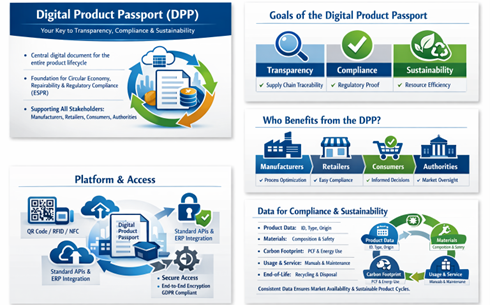
The DPP can be understood as a digital identity for a product. It contains all relevant information associated with that product, typically accessible via a QR code or digital identifier. This information travels with the product throughout its lifecycle, from manufacturing to disposal.
The key objectives of the DPP include:
- Transparency: Making product data visible and accessible
- Sustainability: Supporting circular economy practices
- Traceability: Tracking materials and components across supply chains
- Compliance: Meeting regulatory requirements efficiently
Despite its potential, misconceptions about the DPP remain. It is not merely a database or a compliance checklist but rather a structured and standardised system that requires alignment across industries, IT systems, and regulatory frameworks.
The role of the Digital Data Chain
While the DPP defines what information should be available, the DDC defines how that information flows. The DDC represents a continuous digital thread connecting all stages of a product’s lifecycle—from design and manufacturing to operation and service.
Its core function is to ensure that data remains consistent, up-to-date, and accessible across all stakeholders. This includes manufacturers, suppliers, service providers, and regulators. By integrating data from multiple systems into a unified structure, the DDC improves efficiency, traceability, and decision-making.
In essence:
- The DPP is the product-specific dataset.
- The DDC is the infrastructure enabling data flow.
Together, they form a powerful combination that supports digital transformation and sustainability goals simultaneously.
Industry landscape and stakeholder involvement
The development of DPP and DDC frameworks is not occurring in isolation. Numerous industry associations, standardisation bodies, and organisations are actively contributing to the discussion. These include engineering associations, digital industry groups, and policy organisations, all working to define requirements, timelines, and implementation strategies.
This collaborative environment is both an opportunity and a challenge. While it enables diverse input and innovation, it also leads to fragmented information and parallel initiatives. Companies must navigate a growing number of position papers, guidelines, and regulatory updates, making it difficult to maintain a clear overview.
Implications for industry and next steps
For organisations such as the European Sealing Association (ESA), early engagement is critical. Proactive collaboration with industry bodies and regulatory stakeholders allows companies to shape emerging standards rather than simply reacting to them.
Key recommended actions include:
- Engaging with relevant European associations and committees
- Monitoring ongoing regulatory developments
- Aligning internal processes with future DPP requirements
- Exploring digital infrastructure to support DDC integration
Additionally, there is a growing need for centralised information platforms. Such platforms would consolidate scattered knowledge, provide structured guidance, and help companies anticipate regulatory changes more effectively.
Action: During our AGM meeting in Seville on 15 May 2026, the following members volunteered to become part of the ESG DPP Working Group: Thomas Böhm – EagleBurgmann, Torsten Bernicke – Chesterton, Ronald Noesel – Flowserve, Kamesh Narayanaswamy – John Crane, and we hope for Chrisantos Rich at EagleBurgmann as our moderator, as this article was based on his PPT presentation.
A great thank you to all volunteers!
Conclusion
The Digital Product Passport and Digital Data Chain represent more than regulatory requirements – they are enablers of a more transparent, efficient, and sustainable industrial ecosystem. By linking product data with digital infrastructure, they create a foundation for the circular economy and future digital business models.
However, successful implementation will require collaboration, standardisation, and early strategic action. Companies that engage proactively will not only ensure compliance but also gain a competitive advantage in an increasingly data-driven and sustainability-focused market.
Sandy Van den Broeck,
ESG Director, ESA